ALPR Cameras Explained: How They Work and Who Makes Them
Quick answer: An ALPR camera is a camera system that reads license plates and logs where and when each plate was seen. The term means automatic license plate recognition, and the same technology is also called ANPR. Flock Safety tags cover most of the cameras on our map, but many other companies make ALPR cameras too. Read more on what Flock cameras are.
By PlateMap Atlas Editorial Team. Updated 2026-11-18. Last reviewed 2026-11-18 (what changed: first published, sources re-checked); next review due 2027-02-16.
How we checked this: On 2026-11-18 we read the EFF, OpenStreetMap wiki, ACLU, Genetec, Leonardo, Motorola, Flock and ACTi pages listed under Sources. We tested no camera ourselves. We counted mapped cameras with our own script on the OpenStreetMap snapshot of 2026-11-17. Every source carries a date. See our methodology, editorial policy and contact us to report an error.
This page is for readers who want a plain, sourced explanation. It is not a buying guide.
What is an ALPR camera?
An ALPR camera is a camera designed to record the license plates of passing vehicles. The OpenStreetMap wiki, which volunteers use to tag cameras, also calls the technology automatic number-plate recognition, or ANPR. EFF describes ALPRs as "high-speed, computer-controlled camera systems." In short, the camera takes the picture and software does the reading.
Any camera could feed plate-reading software. However, makers sell some camera models only for plate capture and often add infrared imaging for low light.
How does an ALPR camera work?
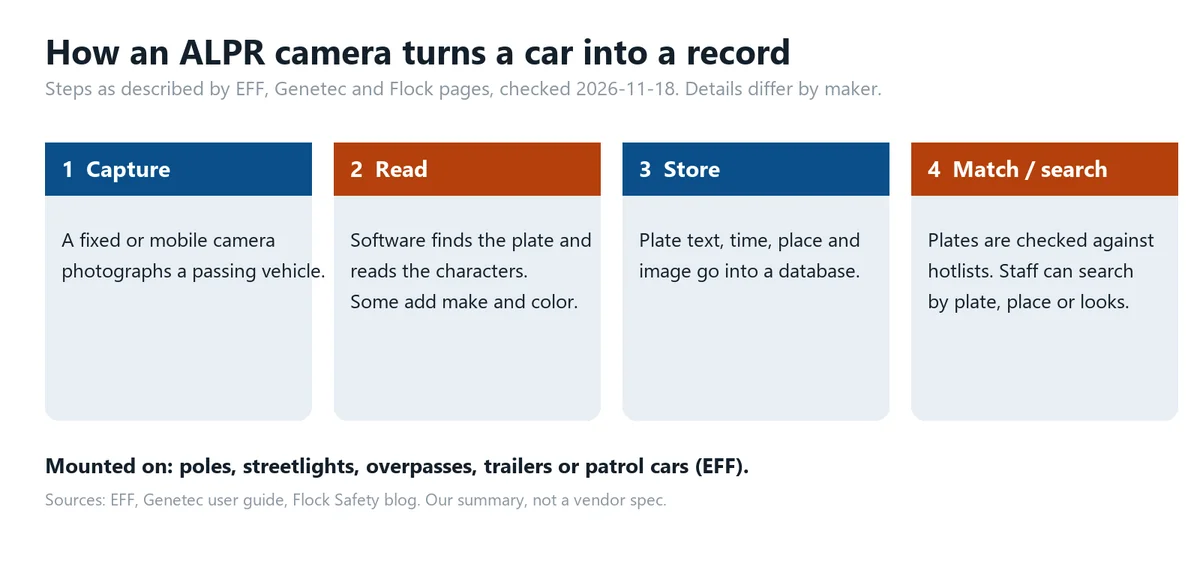
An ALPR camera photographs a passing vehicle, software reads the plate, and the system stores the plate with the time and place. Then the plate can be checked against lists. Later, staff can search the stored data. The diagram above shows the four steps.
Genetec's guide says its cameras send plate images to be matched against lists of vehicles of interest, called hotlists, and vehicles with permits. That is a vendor description, so other makers may differ.
Next comes search. EFF says police can search by plate number or by location. They can also search by a vehicle's characteristics without a plate number. Private companies such as Motorola Solutions or Flock Safety typically host the databases. Agencies can also use regional or national sharing networks.
Specs vary by product. For example, ACTi lists a recognition distance of 4.5 to 900 meters and up to 3 lanes for one of its camera lines. That is a vendor spec, not a test.
What does an ALPR camera record?
An ALPR camera records the plate, the place and the time. Many also log vehicle traits such as color, make and model. EFF adds that the stored data includes photographs of the vehicle and sometimes its driver and passengers.
Flock describes its own sightings the same way. It says a sighting can include vehicle make, color, direction of travel, time, location and, when visible, the license plate. That is the vendor's description.
Retention is a separate question. Each agency sets its own period. EFF says the range runs from as short as three minutes to as long as several years. Flock recommends 7 days for law enforcement customers. That is a recommendation, so ask your local agency for its real setting.
Two common follow-ups have their own pages: do Flock cameras have facial recognition and do Flock cameras record speed.
Where are ALPR cameras mounted?
ALPR cameras typically sit on street poles, streetlights, highway overpasses and mobile trailers, or attach to police squad cars. Genetec says its system can run in a fixed setup on a pole in a parking lot or in a mobile setup on a patrol vehicle. So the same software can serve both kinds.
What do ALPR cameras look like? Our sources give no single look, because makers and models differ. Flock Safety says its cameras run on solar and a battery, send data over cellular (LTE), and need only a few hours of sunlight a day. Flock says its plate cameras use infrared, which lights up reflective surfaces such as plates, and that motion detection works up to 75 feet with a field of view about 20 feet wide at that distance. Flock's FAQ does not state the camera's size, weight, colour or how it is mounted, so we say "not stated." Fixed units are camera systems on street poles, streetlights and highway overpasses, or on mobile trailers. Mobile units are attached to police patrol cars. Genetec's guide gives one fixed example, a pole in a parking lot, and one mobile example, a patrol vehicle. Motorola Solutions lists three product types: fixed, quick-deploy and mobile cameras. Some camera models are sold only for plate capture, often with infrared imaging. Axon says its first ALPR came through an in-vehicle dashcam.
None of the sources we read describes housing shape, color or size, so we do not. Looks differ by maker and model, so check the maker's own product page. To find real units near you, search your city on the camera map or open the full map.
Who makes ALPR cameras besides Flock?
Many companies make them. The OpenStreetMap wiki lists Flock Safety, Motorola Solutions and Leonardo as common makers. The ACLU wrote on August 25, 2026 that Flock has "essentially dominated license plate recognition across the United States." It adds that "Flock is far from the only vendor." The same page says DHS lists 16 providers, and another analyst counts 46 vendors.
This table shows five makers. We built it only from the cited pages (see methodology).
| Maker | Products named | Mounting stated | One labeled fact | Source |
|---|---|---|---|---|
| Motorola Solutions | Fixed, quick-deploy and mobile plate cameras | Fixed, quick-deploy, mobile | Its Vigilant Solutions unit operates the National Vehicle Location Service | Vendor page, ACLU |
| Axon | In-vehicle dashcam; fixed-camera ALPR products | In-vehicle, fixed | Began selling ALPR in 2021; announced fixed products in 2025 | ACLU |
| Genetec | AutoVu | Fixed on a pole; mobile on a patrol vehicle | Not stated | Vendor documentation |
| Leonardo (ELSAG) | ELSAG | Fixed and mobile | Says over 4,000 agencies use its systems (vendor claim) | ACLU, vendor page |
| Rekor | Not stated | Not stated | Provides ALPR services to the Westchester County, NY police | ACLU |
The ACLU is an advocacy group, so we cite it as a position and not as neutral fact. Vendor claims stay labeled as claims. See mapped makers on our manufacturers page.
Where are ALPR cameras mapped?
Volunteers map them in OpenStreetMap, and EFF's Atlas of Surveillance lists police tech, including automated license plate readers, in communities across the United States. EFF says more than 1,000 students and volunteers compiled that database. A Hacker News post of 2026-05-31 carried the title "Deflock hits 100k ALPRs Mapped in USA." We did not verify that number.
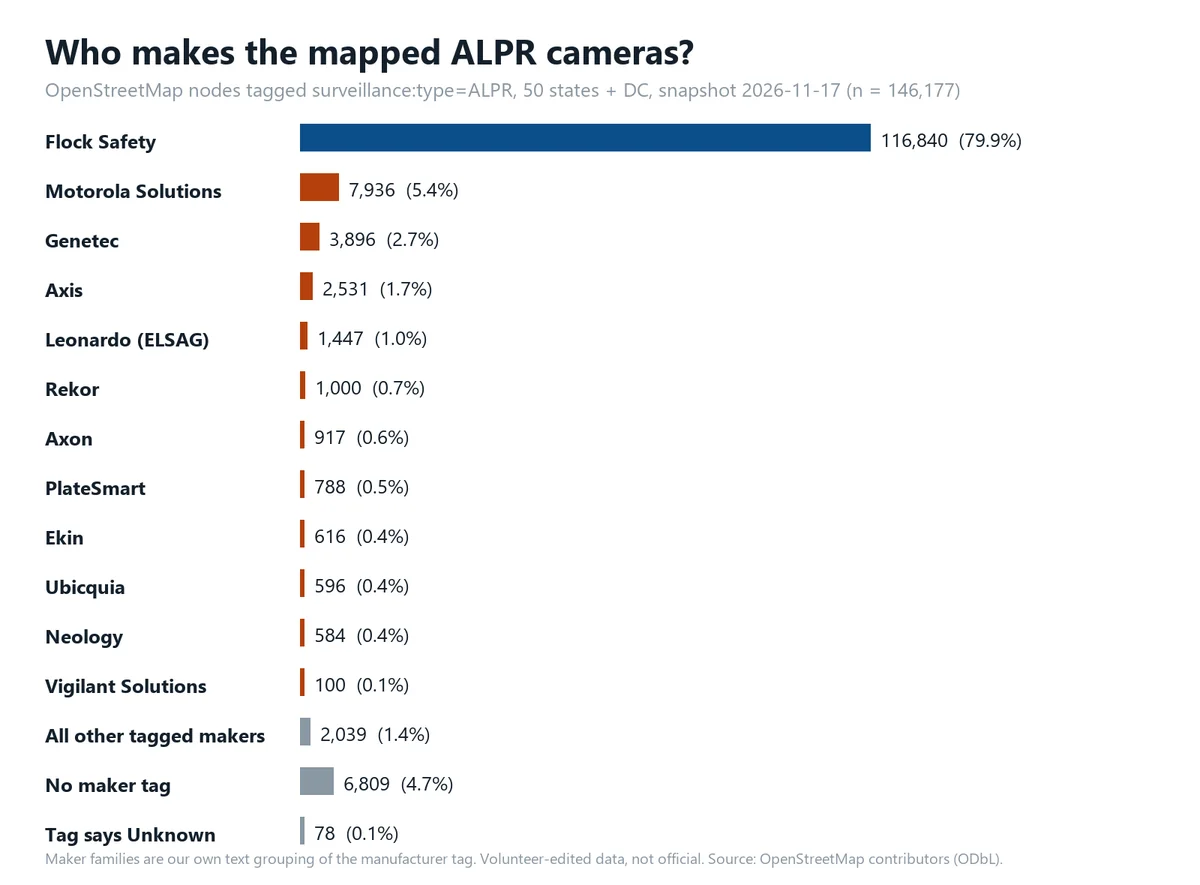
Our own map uses OpenStreetMap. The snapshot of November 17, 2026 holds at least 146,177 mapped ALPR entries in 50 states plus DC. Of those, 116,840 (79.9%) carry a Flock Safety maker tag. Next come Motorola Solutions with 7,936 (5.4%) and Genetec with 3,896 (2.7%).
| Maker family in OpenStreetMap | Mapped entries | Share |
|---|---|---|
| Flock Safety | 116,840 | 79.9% |
| Motorola Solutions | 7,936 | 5.4% |
| Genetec | 3,896 | 2.7% |
| Axis | 2,531 | 1.7% |
| Leonardo (ELSAG) | 1,447 | 1.0% |
| Rekor | 1,000 | 0.7% |
| Axon | 917 | 0.6% |
| Vigilant Solutions | 100 | 0.1% |
| No maker tag | 6,809 | 4.7% |
The table lists only the biggest families, so the rows do not add up to the total. We grouped maker tags by simple text matching, and we count a Vigilant Solutions tag separately from Motorola Solutions.
We also looked at the zone tag. In the same snapshot, 124,513 entries (85.2%) carry the zone tag "traffic," and 16,694 (11.4%) carry no zone tag. Another 1,790 (1.2%) carry the zone tag street and 915 (0.6%) carry parking. These counts are volunteer-edited map data, not official numbers, and they may be incomplete or duplicated. Read how we count on our methodology page.
FAQ
Is an ALPR camera the same as a license plate reader?
In everyday use, yes. Both names describe a camera system that reads plates. The OpenStreetMap wiki says the technology is also known as ANPR, among other names.
Can an ALPR camera see the driver?
It can. EFF says the stored data includes photographs of the vehicle and sometimes its driver and passengers. Flock describes a sighting as vehicle details, time, location and the plate when visible.
How long is ALPR data kept?
It depends on the agency. EFF reports periods from three minutes to several years. Ask the agency that runs the camera for its policy.
Does a map list every ALPR camera?
No. Our count is "at least" 146,177 entries, taken from volunteer edits. Cameras that nobody has tagged are missing.
Is Flock the only ALPR maker?
No. The ACLU says other vendors exist besides Flock. The table above names five others, and the OpenStreetMap data names more.
Conclusion
An ALPR camera reads plates and logs where and when it saw them. Many makers sell them, and Flock tags cover 79.9% of mapped entries. Retention and sharing depend on each agency, so ask for its policy. Treat any single map as a floor, not a full list.
Next step: find your city on our map, then ask the agency which maker it uses.
Sources
- EFF (Tier 2): the page on automated license plate readers, checked 2026-11-18.
- OpenStreetMap wiki (Tier 1): the tag page for surveillance:type=ALPR, checked 2026-11-18.
- ACLU (Tier 2, advocacy position): "other ALPR vendors" piece, August 25, 2026.
- Vendor pages (Tier 1, positions): Genetec user guide, Leonardo, Motorola Solutions, Flock Safety blog (October 19, 2026), Flock Safety FAQ and ACTi.
- EFF Atlas of Surveillance (Tier 2) and a Hacker News post title (Tier 3, title only).
- OpenStreetMap contributors, ODbL, Overpass pull of 2026-11-17, counted by our own scripts.
- More from us: about us, editorial policy, methodology, contact.
Author: PlateMap Atlas Editorial Team. Reviewed 2026-11-18. We are an editorial team, not a legal adviser; this page is not legal advice. We have no first-hand testing of ALPR cameras.